
Advantages and Disadvantages of Automated Trading
Explore the benefits, limitations and risks of automated trading, and understand how it compares with manual trading.
Automated Trading has become an important part of modern financial markets. It allows traders to use computer programs and predefined rules to execute trades automatically. Instead of manually monitoring the market and placing every order, traders can rely on software to perform specific trading tasks.
While Automated Trading offers benefits such as speed, consistency and reduced emotional decision-making, it also comes with certain limitations. Understanding both sides can help traders decide whether this approach suits their trading goals.
Automated Trading: Advantages vs Disadvantages
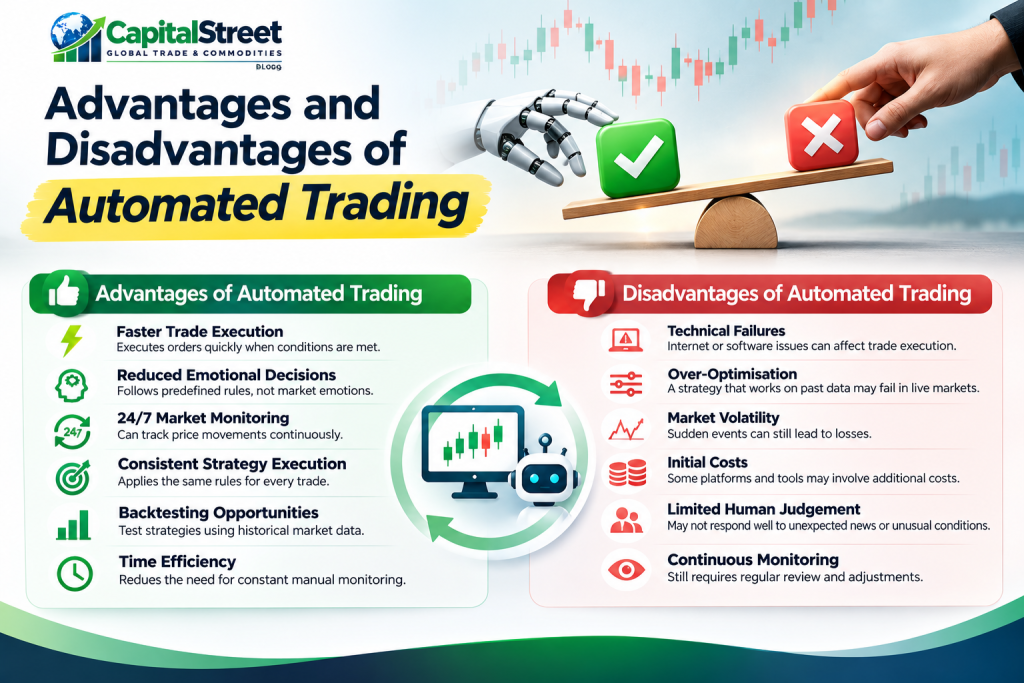
Advantages of Automated Trading
Automated Trading provides several benefits for traders who want to manage their trading activities more efficiently.
Faster Trade Execution
Trading systems can execute orders quickly when predefined market conditions are met.
Reduced Emotional Decisions
Automated systems follow programmed rules instead of reacting to fear, excitement or market rumours.
24/7 Market Monitoring
Depending on the market and platform, software can monitor price movements even when traders are not actively watching.
Consistent Strategy Execution
The system follows the same rules for every trade, helping reduce manual errors.
Backtesting Opportunities
Traders can test strategies against historical market data before using them in live trading.
Time Efficiency
Automation reduces the need to monitor charts and place every order manually.
Disadvantages of Automated Trading
Despite its advantages, Automated Trading has some risks and limitations that traders should understand.
Technical Failures
Internet disruptions, software errors or server problems can affect trade execution.
Over-Optimisation
A strategy that performs well on historical data may not produce similar results in live markets.
Market Volatility
Sudden price movements and unexpected events can create losses even when a system follows its rules correctly.
Initial Costs
Some trading platforms, tools and data services may involve subscription or development costs.
Limited Human Judgement
Automated systems may not understand unexpected news or unusual market conditions unless specifically designed to respond to them.
Continuous Monitoring
Traders still need to review system performance and make adjustments when market conditions change.
Automated Trading vs Manual Trading
Automated Trading and manual trading both have different advantages.
| Automated Trading | Manual Trading |
|---|---|
| Executes trades using programmed rules | Trades are placed by the trader |
| Can respond quickly to market conditions | Execution depends on the trader’s speed |
| Reduces emotional involvement | Emotions may influence decisions |
| Requires software and technical setup | Requires market knowledge and active monitoring |
| Needs regular system checks | Requires continuous personal attention |
The right approach depends on a trader’s experience, strategy, available time and risk tolerance. Some traders also combine automated tools with manual decision-making.
Is Automated Trading Suitable for Beginners?
Automated Trading can be useful for beginners, but it is important to understand how the system works before using real money.
New traders should start by learning basic market concepts, testing strategies through demo accounts and understanding the risks involved. They should also avoid choosing a trading system only because it promises high returns.
A clear understanding of order types, risk management, stop-loss settings and platform features can help beginners use automation more responsibly.
How to Use Automated Trading Responsibly?
Traders should follow a few basic practices to manage the risks associated with automation:
Choose a reliable trading platform.
Test strategies using historical data and demo accounts.
Set suitable stop-loss and position-size limits.
Monitor system performance regularly.
Avoid investing money they cannot afford to lose.
Review strategies when market conditions change.
Important: Automation can support trading decisions, but it does not remove market risk or guarantee profits.
CapitalStreet – Understanding Automated Trading
CapitalStreet provides financial and trading-related information to help readers understand modern market concepts and trading technologies.
Learning about the advantages and disadvantages of Automated Trading can help traders make informed decisions about using technology in their trading activities. Understanding its features, limitations and risks is an important step before adopting any automated strategy.
Explore more educational resources on trading, financial markets and trading technology at CapitalStreet.
Explore CapitalStreetAutomated Trading FAQs
1. What is the biggest advantage of Automated Trading?
One of the biggest advantages is faster trade execution based on predefined rules, without requiring traders to manually place every order.
2. What is the main disadvantage of Automated Trading?
Technical failures, unexpected market conditions and poorly designed strategies can lead to trading losses.
3. Can Automated Trading guarantee profits?
No. Automated Trading cannot guarantee profits because financial markets involve uncertainty and risk.
4. Is Automated Trading better than manual trading?
Neither approach is always better. Automated Trading offers speed and consistency, while manual trading allows human judgement and flexibility.
5. Can beginners use Automated Trading?
Yes, beginners can explore Automated Trading, but they should first understand trading fundamentals, practise with demo accounts and learn risk management.

Author: CapitalStreet Editorial & Business Team
CapitalStreet Editorial & Business Team covers global business, trade, finance, markets, technology, entrepreneurship and Media-for-Equity, connecting businesses and professionals across international markets.