
How Does Algorithmic Trading Work in the COMEX Gold Market?
An educational guide to gold futures, algorithmic strategies, electronic order execution and risk management.
Gold is one of the most actively traded commodities in global financial markets. The COMEX gold market attracts institutional investors, professional traders, hedgers and other market participants who use futures contracts to manage exposure to gold price movements.
With the development of trading technology, algorithms are increasingly used to analyse market data and execute orders automatically. COMEX Gold Algorithmic Trading uses computer-based strategies to identify trading opportunities in gold futures and send orders through electronic trading systems.
Understanding how these algorithms work can help traders learn about the relationship between financial markets, trading technology and automated execution.
What Is COMEX Gold Algorithmic Trading?
COMEX Gold Algorithmic Trading refers to using computer algorithms to analyse price movements and automate trading decisions in COMEX gold futures.
The standard COMEX Gold futures contract is identified by the symbol GC and represents 100 troy ounces of gold. It is traded electronically through CME Globex.
Algorithms can analyse different types of market information, including:
Based on predefined conditions, the algorithm can generate buy or sell signals and submit orders through a supported broker or trading connection.
How Does Algorithmic Trading Work in the COMEX Gold Market?
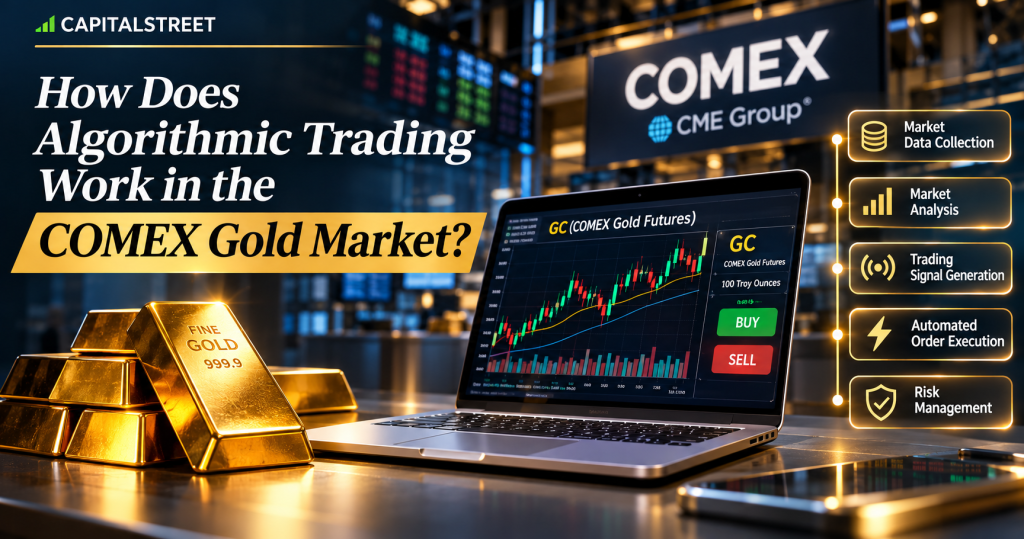
COMEX Gold Algorithmic Trading generally involves several steps, from collecting market data to executing and managing orders.
Market Data Collection
The algorithm receives real-time or delayed market information, depending on the data service being used. It monitors gold futures prices, trading volume and order book activity.
Market Analysis
The software processes the collected data using predefined rules. It may use moving averages, RSI, MACD, price patterns or other quantitative methods to identify potential trading opportunities.
Trading Signal Generation
When the market meets the selected conditions, the algorithm generates a trading signal. For example, a strategy may identify a possible buying opportunity when a short-term moving average crosses above a longer-term moving average.
Automated Order Execution
After generating a signal, the system can submit an order through its broker or authorised trading connection to CME Globex. Orders are processed and matched according to the exchange’s matching rules.
Risk Management
The algorithm can apply position limits, stop-loss instructions and other risk controls. It may also close trades when predefined exit conditions are reached.
Common Algorithmic Trading Strategies Used in COMEX Gold
Traders can develop different strategies depending on their objectives, market conditions and technical requirements.
Trend-Following Strategy
Identifies upward or downward gold price trends using indicators such as moving averages.
Mean Reversion Strategy
Looks for potential price movements back towards a calculated average after an unusually large move.
Breakout Strategy
Monitors important price levels and generates signals when gold futures move beyond selected support or resistance areas.
Arbitrage Strategy
Attempts to identify pricing differences between related markets or financial instruments, considering transaction costs and execution risks.
Volume-Based Strategy
Uses trading volume and order book information to assess market activity and potential price movements.
Every strategy has limitations. Market conditions can change, and historical performance does not guarantee future results.
Role of CME Globex in COMEX Gold Algorithmic Trading
CME Globex is the electronic trading platform used for CME Group futures and options markets, including COMEX Gold futures.
It allows market participants to submit electronic orders through supported trading applications and connections. CME Globex uses matching algorithms to process orders according to the applicable market rules.
It is important to understand the difference between a trader’s algorithm and the exchange’s matching algorithm.
Trader’s Algorithm
Decides when and how to submit orders based on the trader’s predefined rules.
Exchange Matching System
Determines how compatible orders are matched according to exchange rules.
Benefits of Algorithmic Trading in the COMEX Gold Market
Algorithmic trading offers several advantages for participants who use systematic trading strategies.
Faster Execution
Orders can be submitted automatically when predefined conditions are met.
Reduced Emotional Decisions
Algorithms follow programmed rules rather than reacting emotionally to price movements.
Consistent Strategy Application
The same trading conditions can be applied across multiple trading sessions.
Market Monitoring
Systems can monitor supported market data without requiring constant manual observation.
Backtesting
Traders can evaluate strategies using historical gold futures data before live deployment.
Improved Efficiency
Automation can reduce repetitive manual trading activities.
Risks of COMEX Gold Algorithmic Trading
Although algorithmic trading can improve execution efficiency, it also involves important risks.
Gold prices can change sharply following economic announcements and geopolitical events.
Software errors, connectivity problems or system interruptions can affect trading activity.
Slippage and liquidity conditions can cause orders to execute at unexpected prices.
Incorrect trading rules can generate unsuitable signals or repeated losses.
Futures trading involves margin and can create significant losses relative to the capital deposited.
A strategy that performs well on historical data may not perform similarly in live markets.
Traders should test their strategies, monitor system performance and use appropriate risk management controls.
Is COMEX Gold Algorithmic Trading Suitable for Beginners?
Beginners can learn about COMEX Gold Algorithmic Trading, but futures markets require a strong understanding of contract specifications, margin, leverage and order execution.
New traders should first learn how COMEX gold futures work and practise with a simulator or paper trading account. They should also understand the difference between standard Gold futures and smaller-sized contracts before selecting a product.
Using automated software without understanding its strategy or risk settings can result in unexpected losses. Learning the fundamentals should come before deploying an algorithm with real capital.
CapitalStreet – Exploring COMEX Gold Algorithmic Trading
CapitalStreet provides educational information about financial markets, trading strategies and financial technology to help readers understand modern trading methods.
COMEX Gold Algorithmic Trading demonstrates how technology can be used to analyse commodity markets and automate order execution. By understanding trading strategies, CME Globex, contract specifications and risk management, traders can develop a clearer understanding of algorithmic trading in gold futures.
Explore more educational resources on Algorithmic Trading, Automated Trading and Trading Bots at CapitalStreet.
Explore CapitalStreetFrequently Asked Questions
1. What is COMEX Gold Algorithmic Trading?
It is the use of computer algorithms to analyse COMEX gold futures market data, generate trading signals and submit orders automatically through supported trading connections.
2. What is the symbol for COMEX Gold futures?
The standard COMEX Gold futures contract uses the symbol GC and represents 100 troy ounces of gold.
3. Which platform is used for electronic COMEX Gold futures trading?
CME Globex is the electronic trading platform used for COMEX Gold futures. Traders generally access it through supported brokers and trading applications.
4. Which strategies are used in COMEX Gold Algorithmic Trading?
Common strategies include trend-following, mean reversion, breakout, arbitrage and volume-based trading.
5. Is algorithmic trading profitable in the COMEX Gold market?
Profitability depends on the strategy, market conditions, execution costs and risk management. Algorithmic trading does not guarantee profits and can result in financial losses.

Author: CapitalStreet Editorial & Business Team
CapitalStreet Editorial & Business Team covers global business, trade, finance, markets, technology, entrepreneurship and Media-for-Equity, connecting businesses and professionals across international markets.