
How Does Automated Gold Trading Work?
Understand how algorithms analyse gold markets, generate trading signals and execute orders through automated systems.
Gold is one of the most actively followed commodities in financial markets. Its prices can change in response to inflation, interest rates, currency movements, geopolitical developments and global economic conditions. Traders use different strategies to analyse these movements and identify potential trading opportunities.
Automated Gold Trading uses computer programs and predefined trading rules to monitor gold prices and execute trades automatically. It helps traders follow a systematic approach without manually placing every order. However, understanding how these systems work and managing their risks are essential before using them.
What Is Automated Gold Trading?
Automated Gold Trading is a trading method in which software or algorithms analyse gold market data and execute buy or sell orders when specific conditions are met.
Depending on the platform and financial instrument, automated systems can be used for gold-related markets such as:
Gold Futures Contracts
Spot Gold Trading (XAU/USD)
Gold-Related CFDs (Where Legally Available)
Other Exchange-Traded Gold Instruments
Traders can configure rules based on price movements, technical indicators, trading volume and other market signals. The software follows these instructions to manage trades.
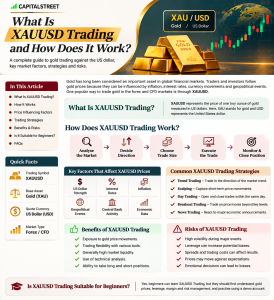
How Does Automated Gold Trading Work?
Automated Gold Trading generally follows a sequence of steps.
Market Data Collection
The software receives gold price information from a broker or exchange. It monitors price movements and other available market data.
Technical Analysis
The algorithm analyses the data using predefined indicators and trading conditions. These may include moving averages, Relative Strength Index (RSI), support and resistance levels or price breakouts.
Trading Signal Generation
When the selected conditions are satisfied, the system generates a potential buy or sell signal.
Automatic Order Execution
The software sends an order through the connected broker or trading platform. Actual execution depends on market liquidity, available prices and the broker’s order-handling process.
Risk Management and Trade Exit
The system can apply predefined stop-loss levels, profit targets and position-size limits. It may close a position when an exit condition is triggered.
Common Automated Gold Trading Strategies
Different strategies can be programmed into automated gold trading systems according to a trader’s objectives and market approach.
Trend-Following Strategy
The system identifies upward or downward price trends and generates trades based on selected indicators.
Moving Average Strategy
It uses moving average crossovers or price relationships to identify possible entry and exit signals.
Breakout Strategy
The algorithm monitors important support and resistance levels and looks for price movements beyond those levels.
Mean Reversion Strategy
It identifies situations where gold prices move significantly away from a calculated average and looks for possible reversals.
News-Based Strategy
Some advanced systems analyse economic data or event-related information, although sudden market reactions can make execution difficult.
Important: No strategy works in every market condition. Traders should test their rules before using them with real money.
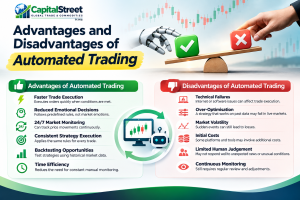
Benefits of Automated Gold Trading
Automated Gold Trading offers several advantages for traders who prefer a systematic approach.
Faster Execution
The software can send orders when predefined conditions are met.
Reduced Emotional Decisions
Automated rules help limit impulsive trading decisions.
Consistent Strategy
The system follows programmed instructions rather than changing decisions based on emotions.
Continuous Monitoring
It can monitor gold prices during the trading hours supported by the connected market and platform.
Backtesting
Traders can evaluate strategies using historical market data before live deployment.
Time Efficiency
Automation reduces the need to watch price charts continuously.
Risks of Automated Gold Trading
Although automation can improve trading efficiency, it does not eliminate financial or technical risks.
Gold prices can move sharply during major economic announcements and geopolitical events.
Internet interruptions, software errors or broker connectivity issues can affect order execution.
Orders may execute at a different price from the expected price, particularly during fast market movements.
An incorrectly configured algorithm may repeatedly generate unsuitable trading signals.
Trading leveraged gold products can increase both potential gains and potential losses.
A strategy that performs well on historical data may fail under real market conditions.
Traders should monitor automated systems regularly and use appropriate risk controls.
Is Automated Gold Trading Suitable for Beginners?
Beginners can learn about Automated Gold Trading, but they should understand gold markets and trading risks before using automated systems with real capital.
Starting with a demo or paper trading account can help new traders understand how algorithms generate signals and execute orders. They should also learn about spreads, leverage, margin, stop-loss orders and trading fees.
It is important to avoid platforms or service providers that promise guaranteed profits. Automated trading systems cannot predict every market movement or eliminate the possibility of losses.
CapitalStreet – Understanding Automated Gold Trading
CapitalStreet provides educational information about financial markets, trading strategies and financial technology to help readers understand modern trading methods.
Understanding how Automated Gold Trading works can help traders explore the role of algorithms in commodity markets. By learning about trading strategies, platform features and risk management, readers can make more informed decisions about automated trading.
Explore more educational resources on Algorithmic Trading, Automated Trading and Trading Bots at CapitalStreet.
Explore CapitalStreetFrequently Asked Questions
1. What is Automated Gold Trading?
Automated Gold Trading uses software and predefined rules to analyse gold prices and execute buy or sell orders automatically through a supported trading platform.
2. How do gold trading bots work?
Gold trading bots monitor market data, analyse selected indicators, generate trading signals and place orders when programmed conditions are met.
3. Can Automated Gold Trading make profits?
It can generate profits when a strategy performs successfully, but losses are also possible. No automated system can guarantee returns.
4. Is Automated Gold Trading suitable for beginners?
Beginners can explore it using demo accounts and educational tools. They should understand gold market behaviour, platform features and risk management before trading with real money.
5. Which indicators are commonly used in Automated Gold Trading?
Common indicators include Moving Averages, RSI, MACD, Bollinger Bands and support and resistance levels. Their effectiveness depends on the strategy and market conditions.

Author: CapitalStreet Editorial & Business Team
CapitalStreet Editorial & Business Team covers global business, trade, finance, markets, technology, entrepreneurship and Media-for-Equity, connecting businesses and professionals across international markets.