
What Is Automated Trading? A Complete Beginner’s Guide
Understand how automated trading systems operate, explore common strategies, evaluate their benefits and risks, and learn the fundamentals of systematic trading.
Technology is transforming the way people participate in financial markets. Traders no longer need to manually monitor every price movement or place every buy and sell order. With the help of automated systems, trading activities can be performed using predefined instructions and computer programs.
Automated Trading allows traders to create specific rules for entering and exiting trades. These systems monitor market conditions and execute orders when the required conditions are satisfied.
This guide explains what Automated Trading is, how it works, its benefits, common strategies and potential risks for beginners.
What Is Automated Trading?
Automated Trading is a method of buying and selling financial instruments through computer programs that follow predefined trading instructions.
These systems use different market conditions and technical indicators to identify potential trading opportunities. Once the programmed conditions are met, the software can automatically generate and execute trading orders through a compatible broker or trading platform.
Automated Trading is also known as algorithmic trading or system-based trading. It can be used in stock markets, forex markets, futures and other financial markets, depending on platform access and applicable regulations.
Automated trading converts a trader’s predefined rules into computer-based instructions that monitor markets and execute eligible orders.
How Does Automated Trading Work?
Automated Trading works by converting a trading strategy into a set of computer-based instructions. The software continuously monitors market information and executes trades according to the programmed rules.
The process generally involves:
Traders define conditions for buying, selling and exiting positions based on price movements, trends or indicators.
The trader establishes entry prices, exit conditions, order quantities and risk management limits.
The system connects with a compatible broker or platform to access market data and submit orders.
Software continuously checks whether market conditions match the predefined trading rules.
When required conditions are satisfied, the system places the relevant buy or sell orders.
Traders monitor results, execution quality and system performance to identify possible improvements.
Types of Automated Trading Systems
Different automated trading systems are designed to perform specific trading activities.
Rule-Based Trading Systems
These systems follow predefined instructions based on price levels, technical indicators and market conditions.
Trend-Based Trading Systems
They identify upward or downward market trends and generate trading signals based on those movements.
Copy Trading Systems
These platforms allow users to automatically replicate the trades of selected traders, subject to platform features and settings.
Expert Advisor (EA) Systems
Commonly used on platforms such as MetaTrader, Expert Advisors automate trading activities based on programmed rules.
Algorithmic Trading Systems
These use mathematical models and computer algorithms to analyse market data and execute orders automatically.
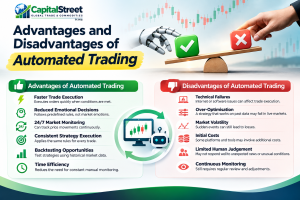
Benefits of Automated Trading
Automated Trading offers several advantages for traders who want to follow a systematic approach.
Time Efficiency
Trading systems can monitor market conditions without requiring continuous manual observation.
Faster Execution
Orders can be submitted automatically when predefined conditions are met.
Reduced Emotional Decisions
Automated systems follow programmed rules rather than reacting to fear or excitement.
Consistent Strategy Implementation
Trading instructions are applied systematically.
Backtesting Opportunities
Traders can test strategies using historical market data before considering live trading.
Multiple Market Monitoring
Depending on system capabilities, traders can monitor several instruments simultaneously.
Risks and Challenges of Automated Trading
Although Automated Trading can make trading operations more systematic, it does not eliminate financial risks.
Internet interruptions, server failures and software errors can affect trading activities.
Poorly designed instructions may result in unwanted trades or unexpected losses.
Sudden price movements can cause slippage and unfavourable order execution.
A strategy that performs well with historical data may not work effectively in changing market conditions.
Automated systems may continue executing trades even when market conditions change unexpectedly, unless appropriate safeguards are in place.
Automated Trading does not guarantee profits, and traders may lose some or all of their invested capital.
Is Automated Trading Suitable for Beginners?
Automated Trading can be explored by beginners, but understanding basic trading concepts is important before using any automated system.
Beginners should first learn about financial markets, price movements, technical indicators, trading strategies and risk management.
It is also useful to practise with demo accounts and simulated trading platforms. This allows new traders to understand how automated systems operate without immediately risking real money.
Before selecting a trading platform, users should review its features, fees, security measures and regulatory requirements.
Automated Trading vs Manual Trading
Automated Trading and manual trading both involve buying and selling financial instruments, but their execution methods are different.
| Factor | Automated Trading | Manual Trading |
|---|---|---|
| Execution | Orders follow programmed rules. | Traders place orders themselves. |
| Market Monitoring | Software monitors market conditions. | Traders analyse market information. |
| Decisions | Based on predefined instructions. | Based on individual trading decisions. |
| Consistency | Rules are applied systematically. | Depends on trader discipline. |
| Control | Through system settings and oversight. | Direct control over individual decisions. |
Automated Trading: Uses computer programs to monitor market conditions and execute orders based on predefined instructions.
Manual Trading: Requires traders to analyse market information, make trading decisions and place orders themselves.
Automated systems can improve execution consistency, while manual trading provides greater direct control over individual decisions. The appropriate approach depends on a trader’s knowledge, objectives and risk tolerance.
Is Automated Trading Legal in India?
Automated Trading is permitted in India subject to applicable regulatory requirements. Traders and brokers must follow the relevant SEBI regulations and stock exchange rules.
Anyone planning to use automated trading systems should check the applicable regulatory framework, broker requirements and permitted trading arrangements before starting.
CapitalStreet – Financial Markets & Trading Technology
CapitalStreet provides information covering global financial markets, trading concepts, financial technology, business developments and investment-related topics.
Understanding Automated Trading can help beginners learn how technology is changing financial market operations and how computer-based systems are used to execute trading strategies.
Explore CapitalStreet.online for more insights into financial markets, trading technology and global business developments.
Explore CapitalStreetFrequently Asked Questions
What is Automated Trading in simple terms?
Automated Trading is a process in which computer programs automatically execute buy and sell orders based on predefined trading rules and market conditions.
How does Automated Trading work?
It works by monitoring market data, identifying trading opportunities and placing orders automatically when programmed conditions are satisfied.
Is Automated Trading profitable?
Automated Trading can help execute trading strategies systematically, but profitability is not guaranteed. Results depend on strategy quality, market conditions, execution costs and risk management.
Can beginners use Automated Trading?
Yes, beginners can learn and explore Automated Trading. However, they should understand basic trading concepts and practise with demo accounts before using real money.
What is the difference between Automated Trading and Algorithmic Trading?
Automated Trading is a broad term for computer-based execution of trading activities. Algorithmic Trading generally refers to using specific mathematical or rule-based algorithms to make trading and execution decisions. The terms often overlap.
Which platforms support Automated Trading?
Several trading platforms offer automated trading features, including MetaTrader and broker platforms that provide compatible APIs or automation tools. Availability depends on the broker and market.
Does Automated Trading require programming knowledge?
Not always. Some platforms provide ready-made automation tools and visual strategy builders. However, programming knowledge can help traders develop and customise more advanced systems.
Is Automated Trading legal in India?
Yes, subject to applicable SEBI regulations, stock exchange requirements and broker rules. Traders should verify the current requirements before using an automated system.