
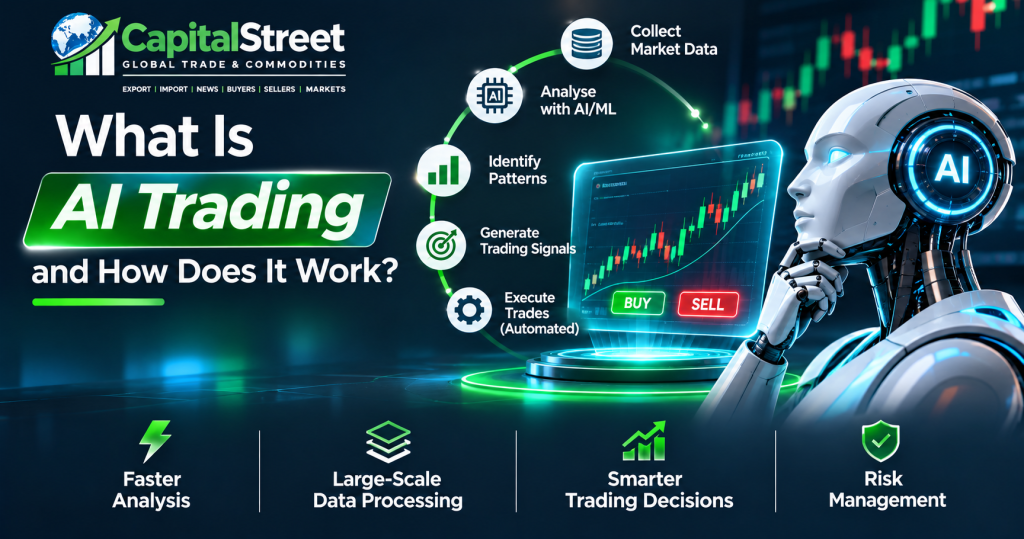
What Is AI Trading and How Does It Work?
Explore how artificial intelligence and machine learning are transforming financial market analysis, trading signals and automated decision-making.
Artificial intelligence is transforming the financial industry by changing how traders analyse market information and make trading decisions. AI Trading uses artificial intelligence, machine learning and data analysis techniques to identify market patterns, generate trading signals and support automated trading activities.
Unlike traditional trading methods that rely mainly on manually defined rules, AI-powered systems can analyse large amounts of historical and real-time market information to identify patterns and adjust their models based on available data.
This guide explains what AI Trading is, how it works, its applications, benefits and potential risks in modern financial markets.
What Is AI Trading?
AI Trading refers to the use of artificial intelligence technologies to analyse financial markets, identify potential trading opportunities and support buying and selling decisions.
These systems can process different types of financial information, including:
AI-powered trading systems use machine learning models, statistical techniques and predefined instructions to analyse this information.
Depending on the platform, AI Trading tools may generate trading signals, suggest strategies, manage portfolios or automatically execute orders through connected brokerage systems.
How Does AI Trading Work?
AI Trading works by combining financial market data with artificial intelligence models to analyse conditions and identify potential opportunities.
The process generally involves:
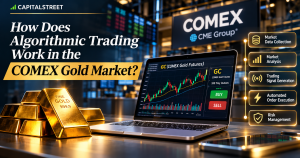
Data Collection
The AI system collects historical and real-time financial information, including prices, trading volumes and relevant market data.
Data Analysis
Artificial intelligence models examine the collected information to identify patterns, relationships and market trends.
Pattern Recognition
Machine learning algorithms analyse historical information to recognise patterns that may help identify potential trading opportunities.
Trading Signal Generation
Based on its analysis, the system generates potential buy, sell or hold signals.
Trade Execution
If connected to a compatible trading platform and configured for automation, the system can execute orders according to predefined conditions.
Performance Monitoring
Traders evaluate the system’s performance and monitor changes in market conditions, model accuracy and risk exposure.
Common Applications of AI Trading
AI Trading can be used for different activities across financial markets.
Predictive Market Analysis
AI models analyse historical and current market data to estimate potential price movements. These predictions are not guaranteed to be accurate.
Sentiment Analysis
Some systems analyse financial news, reports and publicly available information to understand market sentiment.
Automated Trading
AI-powered tools can support automated order placement when connected to compatible trading platforms.
Portfolio Management
AI tools can assist with analysing asset allocation, portfolio exposure and investment-related data.
Risk Analysis
Artificial intelligence can help identify unusual market behaviour, assess potential exposure and support risk management decisions.
Benefits of AI Trading
AI Trading offers several potential advantages for traders and financial market participants.
AI systems can process large volumes of financial information.
Machine learning models can identify complex patterns in historical market data.
Automated systems can analyse market information quickly.
AI tools can support market research, signal generation and certain trading operations.
Depending on the platform, systems can monitor markets whenever data and computing services are available.
AI analysis can provide additional information to support trading decisions.
Risks and Challenges of AI Trading
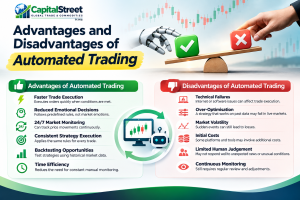
Although AI Trading provides advanced analytical capabilities, it also involves financial and technical risks.
AI models may generate inaccurate trading signals because financial markets are unpredictable.
Incomplete, outdated or incorrect data can affect model performance.
Unexpected economic announcements and sudden price movements can reduce the effectiveness of trading models.
An AI model may perform well with historical data but fail to deliver similar results in live markets.
Software errors, connectivity problems and system interruptions can affect automated trading activities.
AI trading platforms may process sensitive financial and account information, making security an important consideration.
AI Trading does not guarantee profits. Poor model performance and unsuitable trading strategies can result in significant losses.
AI Trading vs Traditional Trading
AI Trading and traditional trading use different approaches to analysing financial markets.
| Aspect | AI Trading | Traditional Trading |
|---|---|---|
| Analysis | AI and machine learning models | Manual research and indicators |
| Pattern Recognition | Model-based data analysis | Trader interpretation |
| Decisions | Signals and model outputs | Human judgement |
| Execution | Manual or automated, depending on setup | Generally manually controlled |
| Risk | Model, market and technical risks | Market and decision-making risks |
AI Trading: Uses artificial intelligence and machine learning techniques to analyse financial data, recognise patterns and generate potential trading signals.
Traditional Trading: Generally relies on manual analysis, technical indicators, fundamental research and decisions made directly by traders.
AI Trading can help process large amounts of information, while traditional trading allows individuals to apply their own judgement and experience.
Both approaches require research, discipline and appropriate risk management.
Is AI Trading Suitable for Beginners?
AI Trading tools can be explored by beginners, but understanding basic financial market concepts is important before using them.
New traders should first learn about market trends, technical analysis, financial instruments and risk management. They should also understand how an AI trading tool generates its signals and whether it executes trades automatically.
Beginners can start with educational platforms, simulated trading environments and demo accounts where available.
It is important to avoid AI trading services that promise guaranteed profits or claim to predict every market movement accurately.
CapitalStreet – AI Trading & Financial Technology
CapitalStreet publishes information covering global financial markets, trading technology, artificial intelligence, automated trading systems, business developments and financial industry insights.
AI Trading is becoming an important area of financial technology, offering new ways to analyse market information and support trading activities.
Understanding how artificial intelligence works in financial markets can help traders explore emerging technologies and make more informed decisions.
For more insights into financial markets, trading technology and global business developments, explore CapitalStreet.online.
Explore CapitalStreetFrequently Asked Questions
What is AI Trading in simple terms?
AI Trading uses artificial intelligence and machine learning technologies to analyse financial market data, identify patterns and support trading decisions.
How does AI Trading work?
It collects financial data, analyses market patterns using AI models, generates potential trading signals and may execute orders through connected trading platforms.
Is AI Trading profitable?
AI Trading can help analyse market information, but profitability is not guaranteed. Results depend on model accuracy, market conditions, trading costs and risk management.
Can beginners use AI Trading?
Yes, beginners can explore AI Trading tools after learning basic trading concepts. Demo accounts and simulated trading are useful starting points.
What technologies are used in AI Trading?
AI Trading may use machine learning, deep learning, natural language processing, statistical modelling and data analytics.
What is the difference between AI Trading and Algorithmic Trading?
Algorithmic Trading uses computer programs to execute predefined trading rules. AI Trading uses artificial intelligence techniques to analyse data, recognise patterns and potentially adapt models. Some advanced trading systems combine both approaches.
Can AI Trading automatically buy and sell stocks?
Some AI-powered trading platforms can automatically execute buy and sell orders through supported broker integrations. Others only provide analysis and trading signals.
Is AI Trading safe?
AI Trading involves financial, technical and data security risks. Users should research the platform, understand its strategy and apply appropriate risk management measures.