
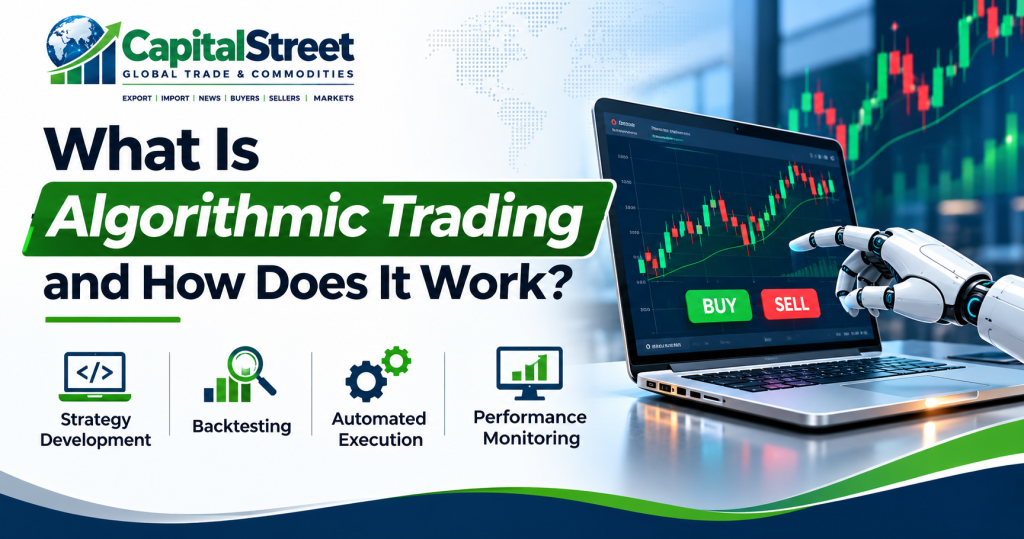
What Is Algorithmic Trading and How Does It Work?
A complete guide to automated trading, algorithmic strategies, market execution, benefits, risks and regulations.
Algorithmic Trading is changing how traders participate in financial markets. It uses computer programs and predefined instructions to analyse market conditions and automatically execute buy and sell orders.
This approach helps traders process market information, identify trading opportunities and manage transactions more systematically.
In this guide, we explain what Algorithmic Trading is, how it works, its common strategies, benefits and risks for traders.
What Is Algorithmic Trading?
Algorithmic Trading, also known as algo trading or automated trading, is a method of executing financial market transactions using computer-based algorithms.
These algorithms follow predefined instructions based on factors such as stock prices, trading volume, market trends, technical indicators and timing.
Instead of manually monitoring every market movement, traders use automated systems to identify opportunities and execute orders when specific conditions are met.
How Does Algorithmic Trading Work?
Algorithmic Trading works through computer programs that analyse market information and follow predefined trading rules. The process generally involves:
Strategy Development
Traders create a strategy based on market trends, technical indicators, price movements or mathematical models.
Algorithm Programming
The trading strategy is converted into computer instructions using programming languages such as Python, Java or C++.
Backtesting
The algorithm is tested against historical market data to evaluate how the strategy performed under previous market conditions.
Market Data Connection
The system connects with a compatible trading platform or broker to receive market information.
Automated Order Execution
When predefined conditions are satisfied, the algorithm generates and submits buy or sell orders.
Performance Monitoring
Traders monitor execution results, technical performance and risk exposure to ensure the system operates correctly.
Common Algorithmic Trading Strategies
Different strategies are used in Algorithmic Trading depending on market conditions and trading objectives.
Trend Following
Identifies market trends and generates trading signals based on price movements and technical indicators.
Arbitrage Trading
Attempts to benefit from price differences between related financial instruments or different trading markets.
Mean Reversion
Identifies situations where an asset’s price moves away from its historical average and looks for potential price reversals.
High-Frequency Trading
Uses advanced computer systems to execute a large number of orders at very high speeds.
Market Making
Uses automated buy and sell orders to provide liquidity in financial markets while managing market exposure.
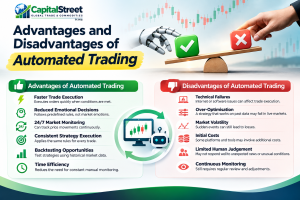
Benefits and Risks of Algorithmic Trading
Algorithmic Trading offers several advantages, but it also involves financial and technical risks.
✓ Benefits of Algorithmic Trading
Computer programs can process information and submit orders quickly.
Automated systems follow predefined instructions instead of reacting emotionally to market movements.
Trading rules are applied systematically across different market conditions.
Algorithms can process large volumes of financial information.
Automated systems can monitor market conditions without requiring traders to manually place every order.
! Risks and Challenges
Internet connectivity problems, server interruptions and software errors can affect trading operations.
Sudden price movements can lead to unexpected losses and unfavourable order execution.
Incorrect instructions can result in unintended trading activity.
A strategy that performs well during historical testing may not produce similar results in live markets.
Automated trading does not eliminate financial risk. Traders need appropriate controls to manage losses and exposure.
Is Algorithmic Trading Legal in India?
Algorithmic Trading is permitted in India subject to applicable regulatory requirements. Traders, brokers and other market participants must follow the relevant SEBI regulations and stock exchange requirements.
Anyone planning to use automated trading systems should understand the applicable rules, broker requirements and compliance procedures before starting.
Who Can Use Algorithmic Trading?
Algorithmic Trading can be used by different market participants, including:
Beginners interested in learning automated trading should first understand financial markets, technical analysis, trading strategies and basic programming concepts.
Practising through historical data and simulated trading environments can help beginners understand how algorithms work before risking real capital.
CapitalStreet – Financial Markets & Trading Technology
CapitalStreet publishes information covering global financial markets, trading concepts, investment-related developments, business opportunities and financial technology.
Understanding Algorithmic Trading can help market participants learn how technology is influencing modern trading operations and financial market activities.
For more financial market insights and trading-related information, explore CapitalStreet.online.
Explore CapitalStreetFrequently Asked Questions
What is Algorithmic Trading in simple terms?
Algorithmic Trading is a method of buying and selling financial instruments using computer programs that follow predefined trading rules and market conditions.
How does Algorithmic Trading work?
It works by analysing market data, identifying trading opportunities and automatically executing orders when specific programmed conditions are met.
Is Algorithmic Trading profitable?
Algorithmic Trading can provide trading opportunities, but profitability is not guaranteed. Results depend on strategy performance, market conditions, execution costs and risk management.
Which programming languages are used in Algorithmic Trading?
Python, C++ and Java are commonly used to develop algorithmic trading systems and automate trading strategies.
Is Algorithmic Trading suitable for beginners?
Beginners can learn Algorithmic Trading by understanding financial markets, technical analysis, programming fundamentals and risk management. Simulated trading is a useful starting point.
What are the main risks of Algorithmic Trading?
The main risks include technical failures, programming errors, market volatility, unexpected order execution and potential financial losses.
Is Algorithmic Trading legal in India?
Yes. Algorithmic Trading is permitted subject to applicable SEBI regulations and stock exchange requirements.